
Three most popular exit strategies

Venture capital runs on optimism. When a fund invests, the startup usually has little or no revenue, and the plan is that in a few years it becomes a large business. The fund still has to get its money back, and the only way to do that is an exit: the moment an investor's shares turn into cash. This guide is for founders who are raising venture capital or already have a fund on the cap table. It explains the three most common venture capital exit strategies (a sale to a strategic investor, a sale to private equity and an initial public offering), the other exit options, how often each one happens, and what makes a deal close.
Updated in November 2026 with current data. First published in September 2022.
What a venture capital exit is
An exit is the liquidity event in which venture capital investors, founders and employees sell their shares in a startup. Before it, equity in a private company is an illiquid asset with a value on paper. After it, the holder has cash or a liquid asset such as listed shares.
Venture capital funds need exits because they work to a deadline. The US National Venture Capital Association puts it this way: "the standard VC partnership agreement lasts for ten years with extensions that in practice mean the partnerships generally run even longer." Inside that period the fund has to invest, help its portfolio companies grow, sell them, and return the capital to its own investors. A venture capitalist who cannot show exits will struggle to raise a new fund.
Exits take longer than most business plans assume. In the US the median time from the first VC investment to an acquisition was 5.08 years in 2025. To an IPO it was 7.85 years, a record, according to the NVCA 2026 Yearbook.
A few exits also pay for everything else. Horsley Bridge, which invests in venture capital funds, gave Benedict Evans data on just over 7,000 venture capital investments made between 1985 and 2014. Around half returned less than the money put in. 6% of deals returned at least ten times the investment and produced 60% of total returns. So a fund asks about the exit strategy before it invests, and the term sheet and the shareholders agreement already hold the rules for it: who can force a sale, who can join one, and who is paid first.
The three most common exit strategies
1. Sale to a strategic investor
A strategic acquirer is usually a larger company from the same or a neighbouring industry. It buys enough shares to take control, sets the strategic direction and plans to keep the business for good. What it pays for is the fit with its own business model: technology and intellectual property, a team, customers, market share, or lower costs once two operations are combined.
Mergers and acquisitions of this kind are the most common exit by far, and they tend to come sooner than a listing. The founders deal with one buyer and are paid in cash or in shares of the acquiring company. Google announced in October 2006 that it had agreed to acquire YouTube "for $1.65 billion in a stock-for-stock transaction".
2. Sale to private equity
Private equity firms buy companies with an established market position, usually a majority stake, and aim for an above-average return over the medium term. Their profit comes from growth in the value of the company and from dividends. The horizon is usually 3 to 7 years, and then the private equity firm sells again. For the management team a buyout means a new owner with another exit ahead. For the venture capital investors it is a full exit.
In Europe buyouts made up 28.1% of VC exit value in 2025, according to PitchBook's annual European Venture Report.
3. Initial public offering (IPO)
In an initial public offering a private company sells shares on the public markets for the first time. The company raises capital from public investors, and the existing shareholders end up with shares that have a daily stock price and can be sold over time.
An IPO is often called the gold standard of exits, because a listing tends to bring the highest valuation. It is also the hardest route. The company needs audited financial statements, regular reporting and a size that interests public investors, and the timing depends on the market more than on the company. PitchBook wrote in its Q3 2026 Venture Monitor: "Despite SpaceX's record-breaking $1.7 trillion listing in Q2, the IPO window has not reopened. Only 18 companies went public in Q3".
Other exit options
These types of exit are less visible than the three above, and in our region they matter more every year.
Secondary sales. An investor sells its shares to another investor and the company stays private. No new shares are issued and the money goes to the seller. In the US, venture secondary sales reached roughly $106.3 billion in 2025, next to $105.2 billion from IPOs, according to the NVCA Yearbook. Secondaries are one of the four things Level2 does: we buy positions from existing investors who need liquidity.
Management buyout or buyback. The management team, or the company itself, buys the investor's stake. In Invest Europe's statistics for 2024, 8 of the 56 companies that venture funds in Central and Eastern Europe exited went this way.
SPAC merger. A special purpose acquisition company is, in the words of the US Securities and Exchange Commission, "typically a shell company when it becomes public". It raises money in its own IPO and then merges with a private company, which becomes public through the merger.
Liquidation or write-off. When a startup fails, its assets are sold, creditors are paid first and investors recover little. Statistics count this as an exit too. In the same Invest Europe report, 16 of those 56 companies were write-offs.
Which exit strategy is the most common?
An acquisition is the most common exit. An IPO is the rarest, and usually the most valuable. When we first published this article, the Q2 2022 PitchBook-NVCA Venture Monitor showed acquisitions at about two thirds of all US exits by number, while public listings took most of the value.
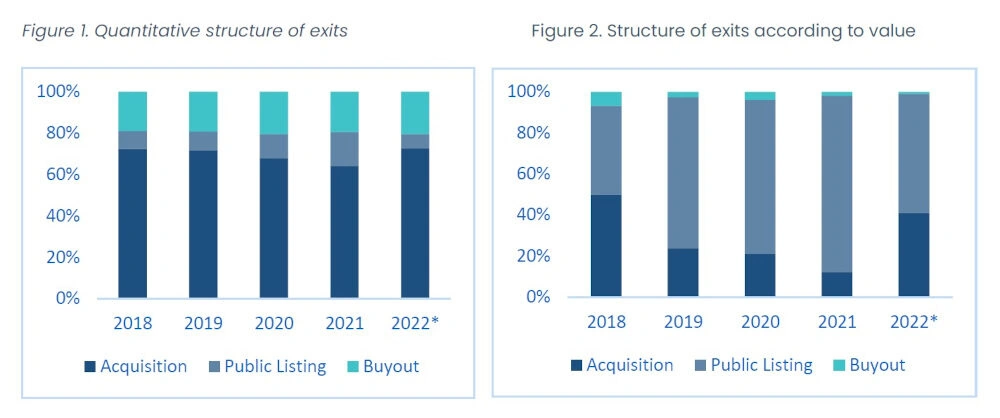
The picture has not changed much. For 2025 the Q4 2025 Venture Monitor counted an estimated 1,635 US exits worth $297.6 billion. Acquisitions were 1,029 of them and brought $140.7 billion, which by our arithmetic is about six exits in ten and just under half of the value. There were 48 public listings. By the third quarter of 2026 PitchBook's own summary was that "M&A has become the preferred, or at least primary, route for liquidity."
Europe looks similar. Exit value in 2025 was €67.8 billion. Acquisitions held 46.4% of it and buyouts 28.1%. Public listings took roughly a quarter, although only 19 VC-backed companies listed, a record low.
In Central and Eastern Europe the numbers are small. Invest Europe counted 39 VC-backed companies exited by funds in 2025. A sale to another private equity firm made up 52% of the value, measured at cost, across four companies. Nine companies went in a trade sale and one in a public offering. In Poland the yearly report by PFR Ventures and Inovo.vc listed nine publicly announced exits in 2025, as XYZ reported.
Our reading for a founder in the region: build the exit plan around a trade sale or a secondary sale, and treat an IPO as the exception.
What drives an exit deal
Deal drivers sit on both sides, with the acquiring company and with the company that sells. Mergers and acquisitions have economic and non-economic reasons. The table below shows the drivers on each side of the deal.
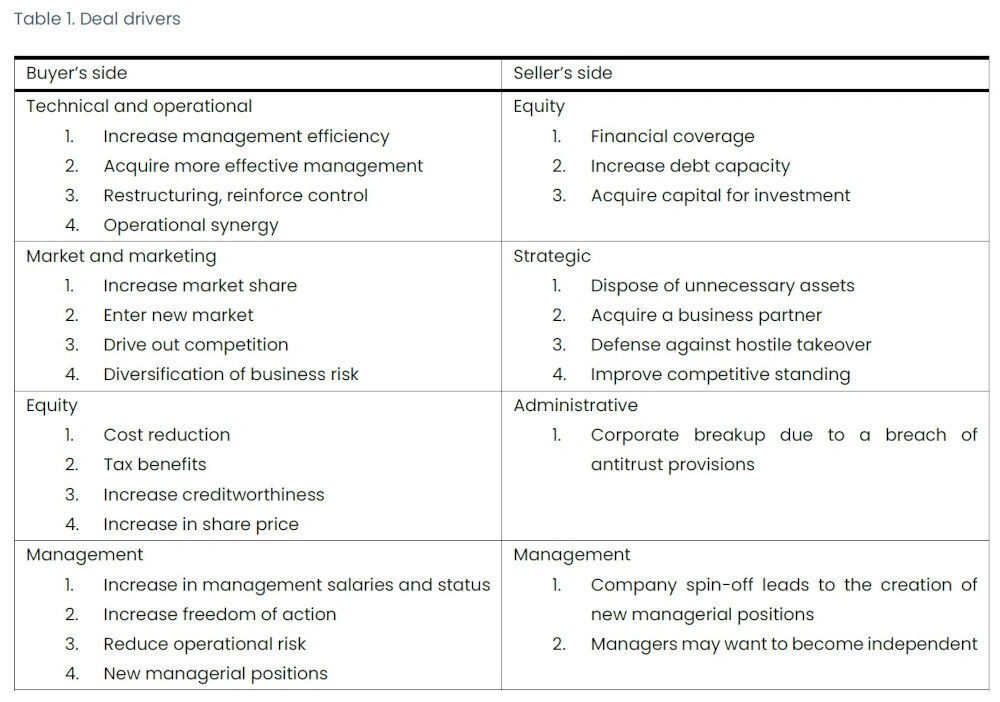
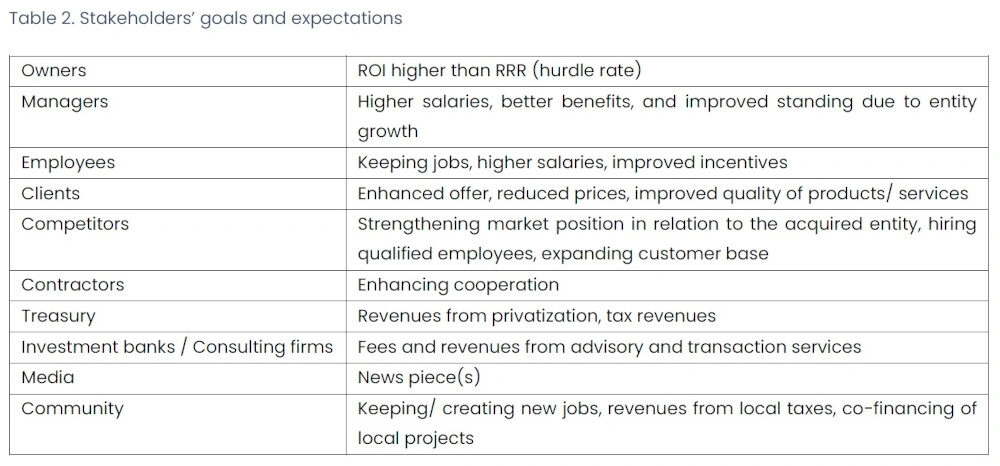
The reasons are usually connected, so it is hard to point to one element that carries a deal to completion. Behavioural theory of the firm adds that a company pursues more than the highest enterprise value. For a deal to close, it has to work for every group with a stake in it. The second table shows what each group wants.
How to prepare for a successful exit
This is what we tell the founders we work with.
Keep the financial statements and contracts in a state a stranger can check. Due diligence starts as soon as a buyer is serious, and every missing document costs time and then price.
Get to know potential acquirers years ahead. A larger company purchases what it already knows, and that is often a partner, a supplier or a customer.
Read the exit clauses before you sign the term sheet. Drag-along, tag-along and the liquidation preference decide who can force a sale and how the money is split.
Ask your investor which year of its life the fund is in. A fund in year eight of ten needs an exit event much sooner than a fund in year two, and that will shape the advice you get.
Questions founders ask
What are venture capital exits?
An exit is the sale of a venture capital investment: the fund sells its shares in a startup and returns the cash to its investors. The common exit strategies are an acquisition, a buyout by private equity, an IPO and a secondary sale.
What are the four basic exit strategy possibilities?
Most lists name four: a sale to another company, an initial public offering, a sale of the shares to another investor (a buyout or a secondary sale), and a buyback by the management or the company. Liquidation is the fifth, for companies that fail.
What is a 5 year exit strategy?
A plan to reach an exit about five years after the investment. It matches the data for acquisitions, where the US median was 5.08 years in 2025. An IPO takes longer: the median was 7.85 years.
What is the 80/20 rule in VC?
It is shorthand for the fact that most venture capital returns come from a few investments. The real distribution is steeper than 80/20. In the Horsley Bridge data, 6% of deals produced 60% of total returns.
Sources:
- NVCA: What is venture capital?
- NVCA 2026 Yearbook, data by PitchBook, April 2026
- PitchBook-NVCA Venture Monitor, Q4 2025, January 2026
- PitchBook-NVCA Venture Monitor, Q3 2026, October 2026
- PitchBook: 2025 Annual European Venture Report, 16 January 2026
- Invest Europe: 2025 Central and Eastern Europe Private Equity Statistics, June 2026
- Invest Europe: 2024 Central and Eastern Europe Private Equity Statistics, June 2025
- XYZ: The long game, how patience shapes success in Poland's VC market, 8 February 2026
- Benedict Evans: In praise of failure, 10 August 2016
- Google press release on the YouTube acquisition, 9 October 2006
- SEC: What you need to know about SPACs, 21 August 2024
- E. Ambukita, Fuzje i przyjęcia jako strategia rozwoju przedsiębiorstwa – aspekty teoretyczne,
- A. Damodaran, Finanse korporacyjne, teoria i praktyka
- P.A. Gaughan, Mergers, acquisitions and Corporate restructurings
- Z. Korzeb, Teoria kreowania wartości dla akcjonariuszy w procesach fuzji i przejęć w polskim sektorze bankowym
- Pitchbook NVCA Monitor Q2 2022.
- www.psik.org.pl